
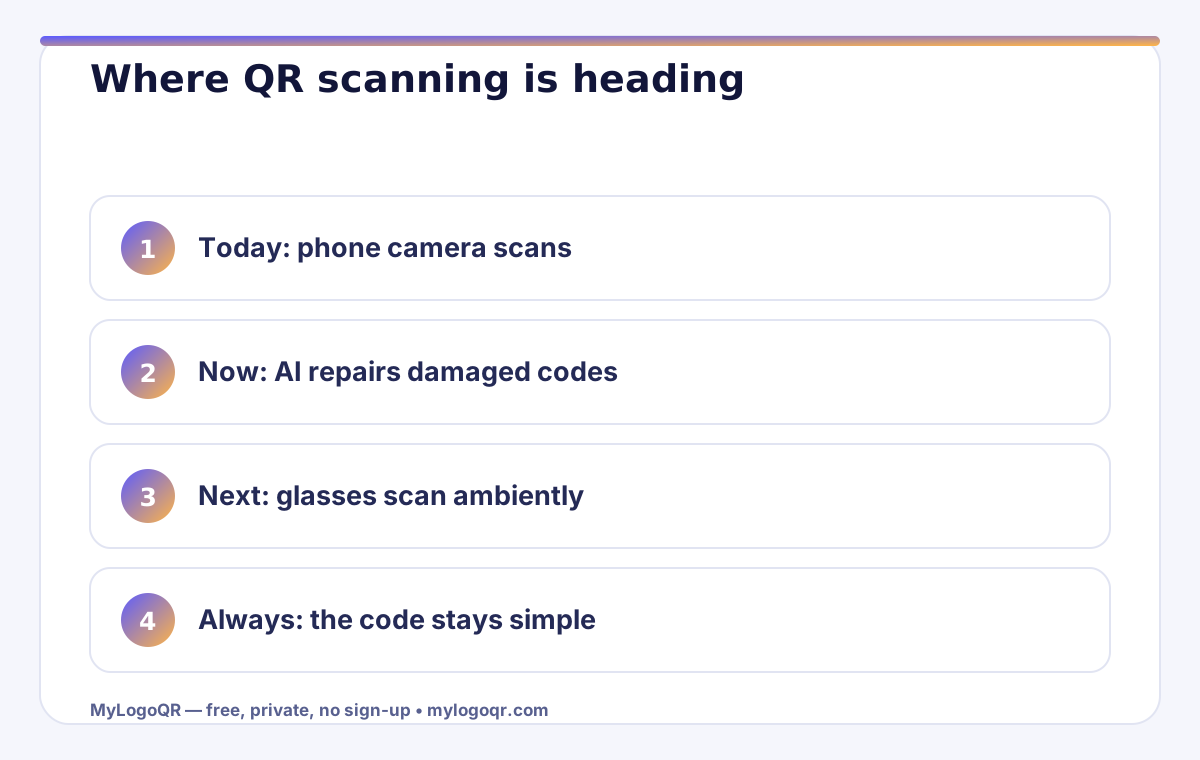
- AI scanners already repair glare, blur and partial damage that stopped older phone cameras.
- Smart glasses and spatial computing will scan codes ambiently — no phone-raising required.
- The code itself stays a simple, open standard; the intelligence is moving into the scanner.
- Businesses win by keeping codes standards-based, high-contrast and pointed at fast mobile pages.

The Thirty-Year Evolution of the 2D Matrix
When Masahiro Hara invented the Quick Response barcode for Denso Wave in 1994, its purpose was humble: tracking automotive components moving down Toyota assembly lines. The barcode was engineered for rugged, industrial laser-line scanners operating under controlled factory conditions. For nearly twenty-five years, barcodes remained an industrial curiosity in Western markets.
The global shift toward contactless mobile interactions in 2020 transformed QR codes into universal consumer infrastructure. In 2026, the convergence of computer vision neural networks, spatial computing headsets, and generative diffusion models is elevating 2D barcodes into the foundational data bridge between physical reality and digital ambient computing.

How Spatial Computing Headsets Use Ambient Barcodes
Devices like Apple Vision Pro, Meta Quest, and enterprise industrial smart glasses continuously construct 3D spatial meshes of the wearer's surroundings. In warehouse logistics, medical cleanrooms, and aircraft maintenance, QR codes serve as instantaneous spatial anchors:
- Heads-Up Inventory Telemetry: A warehouse picker wearing lightweight smart glasses walks down aisle 14. Rather than manually pointing a handheld laser gun at every shelf, the headset's peripheral cameras decode multiple micro-barcodes simultaneously, rendering interactive floating stock counts directly over each physical pallet.
- Surgical Instrument Tracking: In hospital operating theaters, microscopic laser-etched QR codes on surgical steel tools allow automated overhead computer vision cameras to count instruments before and after procedures, virtually eliminating retained foreign object errors.
- Interactive Architectural Schematics: Construction engineers wearing AR helmets look at a physical pillar on a job site. An embedded QR code anchors a 3D holographic projection of the underlying electrical conduits and plumbing lines inside the concrete.
Related Technical Guides

What AI scanning actually changes for everyday codes
Computer vision has quietly removed the QR code's old weaknesses. Modern phone cameras straighten skewed codes, read them through glare and partial damage, and decode at distances and angles that would have failed five years ago. That progress makes design freedom safer — logos, colours and shaped modules that once worried printers are now routine — but it does not repeal physics. A code still needs a recognisable pattern, a quiet zone and honest contrast; AI rescues imperfect codes, it does not resurrect invisible ones. The practical rule is unchanged: design boldly with a tool like the QR code generator with logo, keep the logo near 20–25% with error correction H, and test on a mid-range phone rather than the newest flagship.

Where QR codes go next
Three trends matter more than the artwork experiments that grab headlines. First, the code is becoming a default interface: menus, payments, product passports and event entry now assume a scan, so the skill that matters is choosing the right destination, not decorating the pattern. Second, regulation is arriving — digital product passports in the EU will put scannable codes on everything from batteries to textiles, which means businesses that already print durable static codes are ahead. Third, AI agents will scan on our behalf: assistants that read a code, summarise what it opens and warn about suspicious destinations. Codes generated privately in the browser, with the destination visible and permanent, are exactly the kind that survive that scrutiny. The future rewards codes that are honest, durable and scannable — the same virtues that made the format win in the first place.

What businesses should do with this future now
None of this requires waiting. The winning move today is boring: standardise on durable codes for anything printed, generated privately with your brand in the centre, pointed at pages you control and can update. Audit the codes already in the wild with fresh eyes — AI scanners forgive a lot, but a code whose destination died in a website redesign fools no algorithm. Where a code earns money, such as packaging and menus, keep a small testing ritual: each reprint gets scanned on a mid-range Android and an older iPhone before approval. And treat the coming product-passport rules as free advertising for readiness: suppliers who already print compliant, working codes will look competent while competitors scramble. The revolution, when it fully arrives, will mostly reward people who got the basics right early.
The bottom line: AI is making scanners more forgiving and codes more important at the same time. Businesses that print durable, honestly-built codes today — branded, tested, and pointed at pages they control — are preparing for that future with the tools already in their hands, at no cost and with no subscription.

What AI scanning changes — and what it does not
It is tempting to assume AI scanners make design rules obsolete. They do not. Neural super-resolution and perspective correction widen the margin — a code at an angle, behind glass or partly shadowed now scans where a 2018 phone failed — but the physics underneath is unchanged: the scanner still needs a findable pattern, a decodable contrast difference and enough intact modules to reconstruct the payload. The future of QR codes with AI and computer vision is therefore best understood as a bigger safety margin on the same fundamentals, not a licence to bury codes in artwork.
For businesses creating codes today with a QR code generator, the practical translation is simple: keep doing the boring things right — contrast, quiet zone, sane data length — and AI quietly converts your near-misses into successful scans instead of frustrated customers.

Preparing your QR codes for glasses, cars and ambient scanning
The next scanning surface is not a phone. Smart glasses read codes in the wearer's line of sight, car dashboards scan parking and charging codes, and retail shelf systems inventory coded products automatically. All of these scanners share two traits: they scan from farther away and at steeper angles than a hand-held phone. That shifts the design brief toward size and simplicity — bigger modules, shorter payloads and minimal decoration travel best across every scanner generation.
- Keep payloads short: a clean short URL beats a long parameter-heavy one
- Prefer larger print sizes — ambient scanners rarely get a second, closer pass
- Avoid glossy lamination that mirrors ceiling light into lenses
- Point codes at pages that load fast on any connection, human or machine
Frequently asked questions
Will AI make QR code design rules obsolete?
No. AI scanning tolerates more damage and distortion than before, but a code still needs contrast, a quiet zone and a complete pattern to be read reliably.
Are artistic AI-generated QR codes safe for business use?
Only after rigorous testing on real devices and print materials. Decorative codes fail more often; a branded code with a centre logo and high error correction is the safer professional choice.
Will QR codes be replaced by NFC or image recognition?
Unlikely soon. QR codes cost nothing to print, work on every phone camera and hold their data visibly — advantages no tap-based or cloud-based rival matches at scale.
Will AI make QR codes themselves more complex?
No. The QR standard is fixed and open; the improvement is happening in scanner software. Codes you generate today will remain readable by future scanners.
Should businesses wait for newer QR technology before printing codes?
No — codes printed today follow the same standard future devices read. Print with generous size and contrast, and your codes are already future-proof.